History

Great Fire of London

Step back in time to experience the events of 1666 with our immersive VR. Students see London before the fire, watch the flames spread, then compare the old city with the skyline of today.

1,800+
Students per year
383,000+
Students reached
EYFS–Y6
All ages welcome
Students learning about the Great Fire of London

Duration

35–40 mins

Class Size

Up to 32

Suitable For

KS1–KS2

What's Included

VR + Resources

Bring one of history's most dramatic events vividly to life

The Great Fire of London workshop uses virtual reality to transport students to 1666. Rather than simply learning facts, children stand in the crowded wooden streets of old London, watch the fire leap from roof to roof, and then see the modern City that grew in its place. The immersive nature of VR makes this pivotal historical event memorable and emotionally engaging.

Year 1 and Year 2 students explore the fire through guided VR experiences, role-play activities, and hands-on investigations. They create before-and-after maps of London, investigate how people fought the fire with limited technology, and write diary entries from Samuel Pepys' perspective. Every activity builds understanding of cause and consequence.

Book a full-day visit and choose a different VR topic for every year group — making it super specific to each class's curriculum and exceptional value for money.

Immersive VR Experience

Immersive VR Experience

Each session includes a Virtual Reality segment where students are transported back in time. Using class sets of VR headsets, children explore 360° recreations of historical environments — from walking through ancient temples to witnessing the Great Fire of London.

360° Environments
Fully immersive historical recreations
Shared Headset Experience
One headset between two, per screen time recommendations
Guided Experience
Facilitator-led narration throughout
Curriculum Aligned
Mapped to National Curriculum KS1/KS2
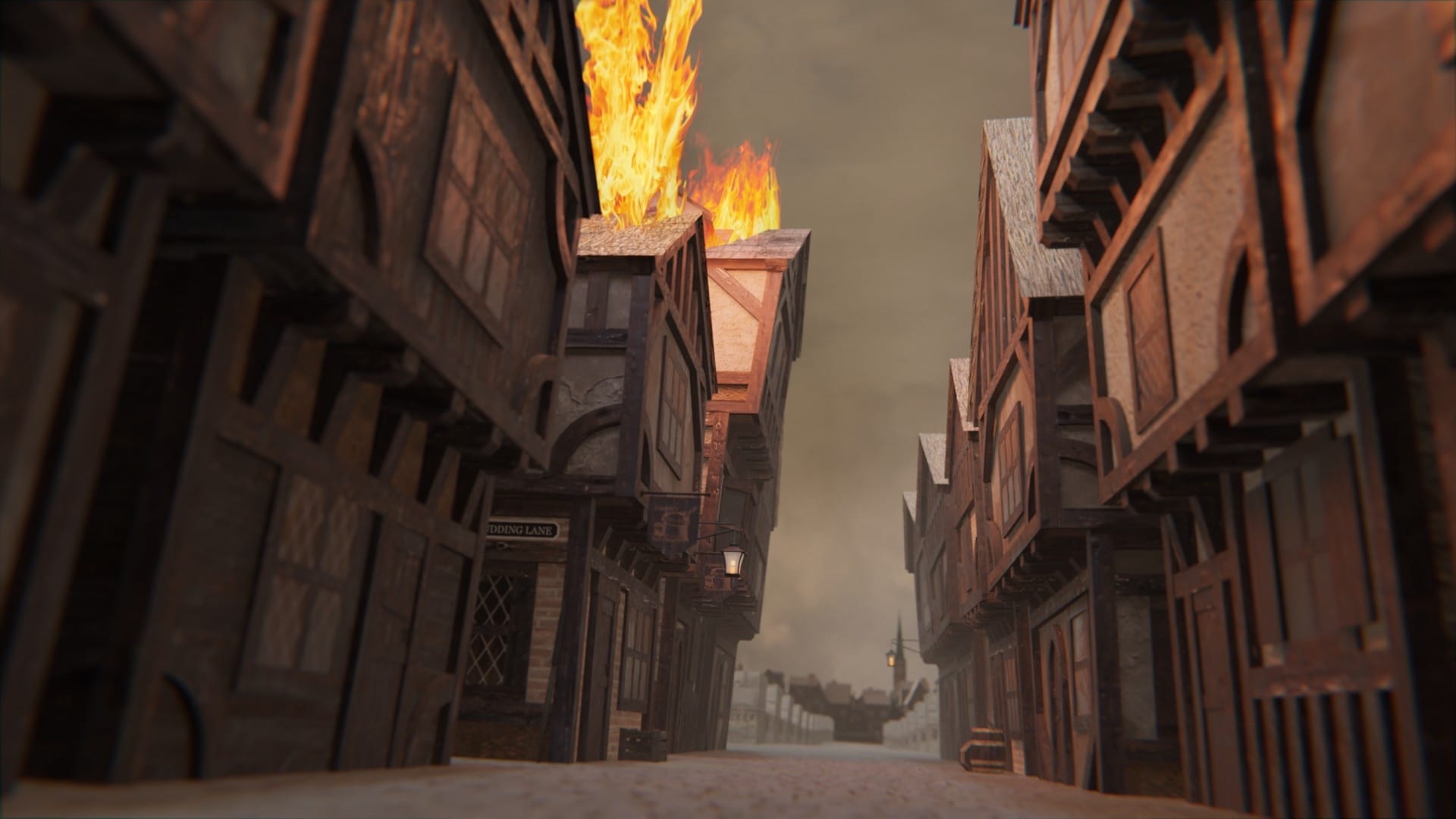
Five VR scenes, adapted by age

Every activity is designed to bring history to life. Your facilitator selects and adapts activities based on the year group.

1

London in 1666

Step into London just before the fire — wooden buildings, narrow streets and bustling markets. Students find out how the fire started in Thomas Farriner's bakery on 2 September and why the city was so easy to burn.

All year groups
2

London Today: Gherkin & Lloyd's

Jump forward to the modern City and compare. Standing among landmarks like the Gherkin and the Lloyd's building, students spot how London was rebuilt with stronger, fireproof materials — the 1666 skyline against today's.

All year groups
3

The Great Fire of London

Watch the fire rage across the city for five days, destroying more than 13,000 buildings. Students learn how people pulled down houses to make gaps the flames could not cross.

All year groups
4

Home Destroyed by Fire

Explore a house after a fire and talk about what it means for the people who lived there. A calm, guided scene that helps children understand why fire safety matters.

All year groups
5

Fire Alarm Practice

Finish by putting it into practice. Students rehearse what to do when they hear a fire alarm — stay calm, walk to the nearest exit, never go back for belongings, and meet at the assembly point.

All year groups

What students take away

Every session is designed around measurable outcomes that align with the National Curriculum and build historical thinking skills.

Cause and consequence

Students understand how the Great Fire changed London and led to new building regulations.

Chronological understanding

Students can sequence events and understand how history unfolds over days and weeks.

Historical significance

Students recognise that some events are so important they change the course of history.

Then, now and staying safe

Students can compare London in 1666 with the city today, imagine living through the fire, and explain what to do if they hear a fire alarm.

The VR experience was extraordinary. Year 2 students were genuinely moved by seeing London burning. Afterwards, they had real questions about why people stayed and how they escaped — the experience sparked genuine historical curiosity.
History Subject Lead
Primary School, London

Simple, transparent pricing

We bring everything — facilitator, VR headsets, resources, activity kits. You just tell us the date and year groups. No hidden costs, no extras.

Half Day

Up to 4 sessions
£599
Up to 4 workshops · £4.68 per pupil
  • 40 min (Y3–6) · 35 min (Y1–2 & EYFS)
  • Up to 32 pupils per session
  • EYFS–Year 6 adaptable
  • VR & all resources included
  • Dedicated facilitator

Sample full-day timetable

Here’s how a typical full-day VR history workshop fits around your school day. KS2 sessions run 40 minutes; KS1 & EYFS sessions run 35 minutes. We’re flexible — we’ll work around your timetable.

9:00–9:40
Session 1
Y3 · 40 min
9:45–10:25
Session 2
Y4 · 40 min
10:25–10:40
Morning break
10:40–11:20
Session 3
Y5 · 40 min
11:25–12:05
Session 4
Y6 · 40 min
12:05–1:00
Lunch break
1:00–1:35
Session 5
Y1 · 35 min
1:40–2:15
Session 6
Y2 · 35 min

Mix and match your workshop day

Schools love booking a VR History day alongside our hands-on Future Skills workshops — giving students a full spectrum of immersive learning experiences in a single day or across the term.

View Future Skills Workshops →
📅 Ready to book?

Bring this workshop to your school

Pick your dates and we'll match you with the perfect presenter. Most schools book in under 2 minutes — full pricing, availability and presenter confirmed instantly.

Book This Workshop →
⭐ Trusted by 1,800+ UK primary schools · Rated 9.3/10

Have a question before you book?
Email us at hi@spark2.org — we reply within one working day.