World Space Week 2026 · 4–10 October

Rocket Revolution.
Beyond a planet poster.

A free, ready-to-run primary classroom kit for World Space Week 2026. Five daily themes — Rockets, the Moon Race, Reusable Rockets, Artemis II, Mission to Mars — plus four ready-to-run differentiated assembly decks (EYFS, KS1, LKS2, UKS2), KS1 and KS2 activities, a parent letter, and a trusted-resources directory. Every deck pitched at the right level for the children in front of you.

World Space Week 2026
Sun 4 Oct — Sat 10 Oct · UN-declared
2026 theme
Rocket Revolution · Artemis II flew this year
EYFS – Y64 differentiated decks
5 daysOne mission per day
~14 minsPer assembly
FreeNo sign-up needed
Spark2 Space Exploration VR workshop in action
🚀

The 5-Day Rocket Revolution Plan

One mission per day. A small, concrete activity that fits in any classroom. Five days that build to a generation thinking about Mars.

Mon · Day 1

How Rockets Fly

Newton’s 3rd Law

Push down, pop up. The science of action and reaction. Why a rocket needs to throw stuff out the back to go forward.

Try this: The balloon-rocket race. Tape a balloon to a straw on a string. Let go. The original Falcon 9.
Tue · Day 2

The Moon Race

Apollo 11 · 1969

Two countries, one Moon, eight years. The Saturn V (taller than 36 houses), Neil and Buzz, the day the world stopped.

Try this: Read the “one small step” line aloud and ask: what would you say if you were the next person to land?
Wed · Day 3

Reusable Rockets

SpaceX · Falcon 9

Why throwing the rocket away made space stupidly expensive. How catching it back changed the game and dropped the price.

Try this: Watch a 30-second SpaceX booster-landing clip. Spot the engineering. Spot the moment that should be impossible.
Thu · Day 4

Artemis II

Earlier this year · 2026

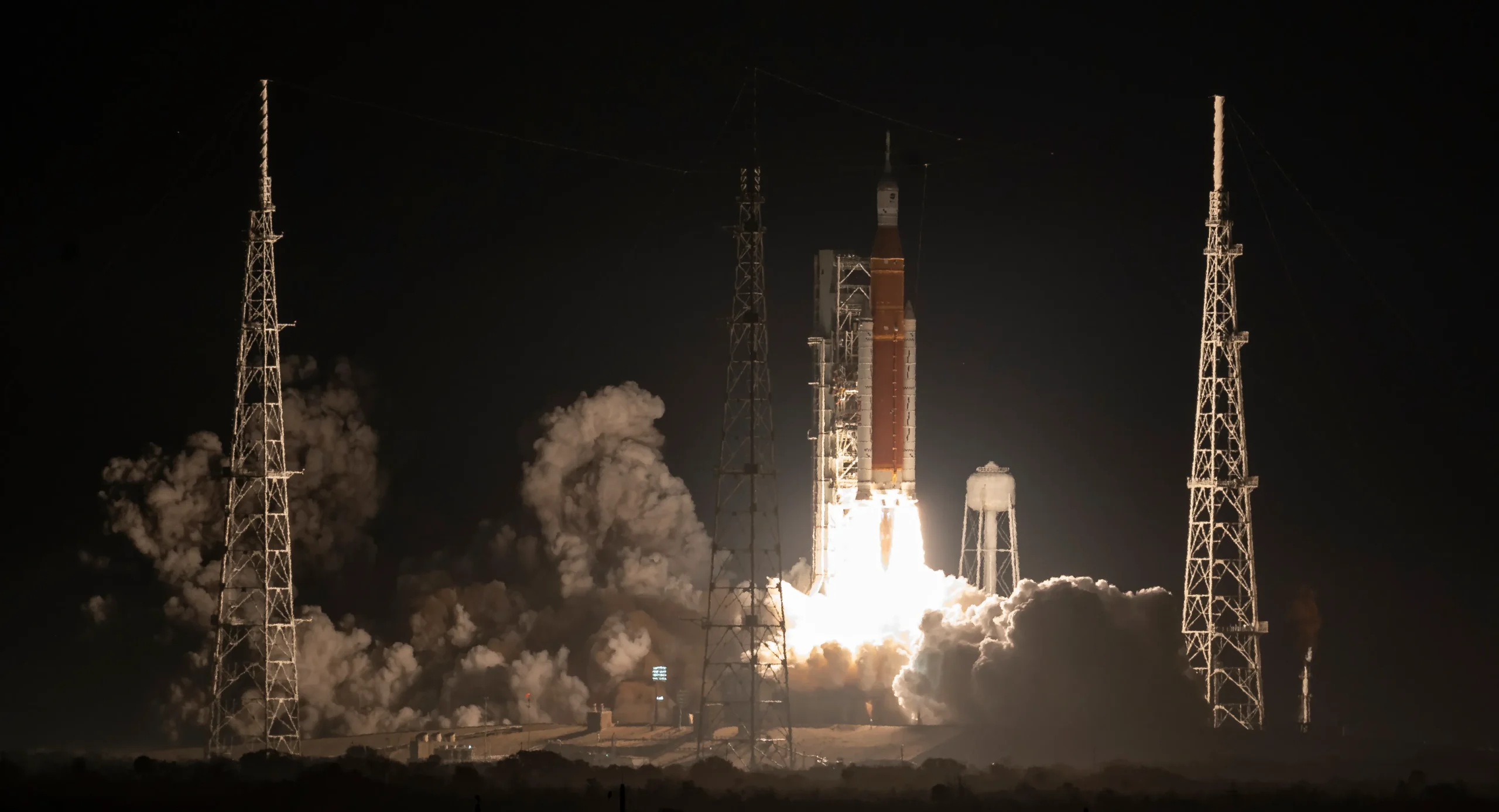
Four astronauts orbited the Moon for the first time in over 50 years. The first woman, the first person of colour, all going further than any human in history.

Try this: Look up the Artemis II mission and its journey around the Moon (NASA). Drop a paper marker on the classroom moon poster.
Fri · Day 5

Mission to Mars

Pledge

The Mission Pledge. Each child picks one thing they’ll get curious about — one question they’ll find an answer to before next term.

Try this: Mission cards children take home. “My space question is ____.” Family helps find the answer. Photos for the parent newsletter.
📢

Four Differentiated Assembly Decks

Unlike most awareness-week assemblies, this one isn’t one-size-fits-all. Pick the deck that matches the year group in front of you. Each runs ~14 minutes and tells the same story at a different reading age.

Reception · Ages 4–5
EYFS

The Big Rocket & The Moon

For the youngest children. Lots of pictures, simple words, big rocket noises. The Saturn V as “tall as 36 houses stacked up.” Concept-led: what is a rocket, what is a moon, what is space?

Open EYFS deck →
Years 1–2 · Ages 5–7
KS1

The Moon Race

For Year 1 and Year 2. Two countries, one race, 1969. Neil and Buzz, the moon landing day, the giant leap. Key facts in pictures plus a few easy numbers.

Open KS1 deck →
Years 3–4 · Ages 7–9
LKS2

Stages, Apollo & the Moon

For Year 3 and Year 4. Vocabulary stretches into “stages,” “Apollo,” “Saturn V” with dates and stats. Steps up the science without losing the story.

Open LKS2 deck →
Years 5–6 · Ages 9–11
UKS2

From Fireworks to Mars

For Year 5 and Year 6. Full timeline of rocketry from fireworks to reusable boosters. Apollo 11, SpaceX, Artemis II as a 2026 anchor. Built for the curriculum’s Earth and Space unit.

Open UKS2 deck →

Classroom Activities

Two ready-to-go activities per phase. 25–45 minutes each. Materials are basic — balloons, straws, kitchen-roll tubes, paper.

KS1 · EYFS–Y2

Balloon Rocket Race

Time: 30 minutes · Day: Best on Mon (How Rockets Fly)

Newton’s 3rd Law in 30 minutes. Tape a balloon to a straw on a long string. Let go. The original SpaceX. Children build, race, and feel the science instantly.

  1. Run a long string across the classroom from one corner to another, threaded through a drinking straw.
  2. Each child blows up a balloon (don’t tie it) and tapes it to the straw.
  3. 3, 2, 1, release! The air rushes out the back — the balloon shoots forward.
  4. Discuss: what happens if we tape two balloons together? What if the string is angled up? Try it.
Materials: Balloons (1 per child + spares), drinking straws, masking tape, long string. Tip: pre-thread 4 string-runs across the room before the lesson.
KS1 · EYFS–Y2

Astronaut Snack Pack

Time: 25 minutes · Day: Best on Tue (The Moon Race)

Children design their own “astronaut snack pack” for a 3-day moon mission. Dehydrated foods only. No fizzy drinks (they explode in space). Real-science constraints, fun outcome.

  1. Show two photos: one of an astronaut’s real food packet (NASA freeze-dried beef stew); one of a packet of crisps.
  2. Explain the rules: no liquid that splashes, no crumbly food (floats away and gets in equipment), nothing fizzy (explodes), enough calories for a working day in space.
  3. Each child draws their own snack pack on an A4 packet template — 3 items, with reasons.
  4. Pin every snack pack on the “Mission Galley” wall for the rest of the week.
Materials: A4 paper, felt-tips, the NASA “astronaut food” photo (free in the kit’s resources directory).
KS2 · Y3–Y6

Egg-Drop Landing Capsule

Time: 45 minutes · Day: Best on Wed (Reusable Rockets) or Fri

The classic engineering challenge with an Apollo / Mars rover twist. Children design a landing capsule that protects an egg dropped from a height. Real engineering: payload protection, materials science, iteration.

  1. Each pair gets one raw egg + a fixed budget of materials (10 cocktail sticks, a paper plate, 3 sheets of A4, 30cm of string, masking tape).
  2. 15 minutes design + 15 minutes build. They’re engineers at NASA Houston.
  3. Drop test from a 2m height (safely, over a tray). Egg survives = mission success.
  4. The teams who failed iterate — what would they change? That’s how Apollo 11 actually worked. Apollo 1 to 10 mostly didn’t.
  5. Discussion: which design worked best? Why? Crumple zones, parachutes, low centre of gravity — which features did the survivors share?
Materials: Raw eggs (1 per pair + spares), cocktail sticks, paper plates, A4 paper, string, masking tape. Plastic tray for landings. Optional: outdoor space for higher drops.
KS2 · Y3–Y6

Solar System Scale Walk

Time: 40 minutes · Day: Best on Thu (Artemis II) or Fri

The solar system at scale, on the school playing field. Children walk the distances from the Sun to each planet to scale. The mind-blowing realisation: most of the solar system is empty.

  1. Pace out 100m on the school field. The Sun is at one end (a tennis ball = the Sun at this scale).
  2. Each child gets a planet card with its scale distance from the Sun (Mercury 4m, Venus 7m, Earth 10m, Mars 15m, Jupiter 52m, Saturn 95m, Uranus 192m, Neptune 300m — you’ll need a longer field for Neptune, or stop at Saturn).
  3. Children walk to their position. From space, the planets are dots in mostly empty space.
  4. Bonus: at this scale, the nearest star (Proxima Centauri) is in Madrid.
  5. Discussion: why is space called “space”? It really is mostly nothing.
Materials: Trundle wheel or 100m measuring tape, planet cards (printable from this kit), tennis ball for the Sun. Outdoor space.
💬

Parent Communication Template

A short letter you can send home Monday morning, or paste into the school newsletter. Tells parents what we’re doing and how to extend it.

Letter / Newsletter Insert

World Space Week at [School Name]

Dear Parents and Carers,

This week (4–10 October) is World Space Week, the largest space education event in the world. We’re using it as a chance to spark curiosity about science and engineering. Five days, five missions: How Rockets Fly, The Moon Race, Reusable Rockets, Artemis II, and Mission to Mars.

Each day children will explore one mission through hands-on activities — balloon-rocket races, designing astronaut food, an egg-drop landing capsule, and walking the solar system to scale on the school field. By Friday, every child writes a Mission Pledge: one space question they’ll get curious about and find an answer to.

This year is especially exciting because Artemis II — NASA’s first crewed Moon mission in over 50 years — flew earlier this year. Your children will be talking about the astronauts who circled our nearest neighbour as they read this letter.

How you can join in at home:

· Step outside on a clear evening and look at the Moon together. Astronauts flew around it again this year — the first crew in over 50 years.
· Borrow a children’s book from the library. We recommend Hello, World! Solar System (EYFS), The Darkest Dark by Chris Hadfield (KS1), and Tim Peake’s The Cosmic Diary of Our Incredible Universe (KS2).
· Watch a 5-minute SpaceX launch clip together. The booster lands. It’s mind-bending.
· Ask your child what their Mission Pledge is — help them find the answer this weekend.
· Look up where the International Space Station is right now (free apps: ISS Live, NASA app). Wave to it.

Useful resources for parents include NASA Space Place (kids’ site), ESA Kids, and Tim Peake’s Principia archive.

With best wishes,
[Headteacher / Science Lead]
📚

Space & STEM Resources

Trusted UK and international resources for primary schools and parents. Use alongside this kit.

NASA · Kids’ Club & Space Place

Free games, videos, mission tracking

The single best space-for-kids resource on the internet. Live ISS tracking, Artemis updates, simulator games, age-banded content from EYFS to Year 6.

spaceplace.nasa.gov →

ESA · European Space Agency

Free schools resources, KS1–KS3

European Space Agency’s primary resource library. Solar System packs, Earth observation lessons, ESA Kids portal aligned to the British curriculum.

esa.int/kids →

UK Space Agency · Principia

Tim Peake’s mission archive

The full Principia mission resource library. Designed for UK primary teachers. Live videos, classroom experiments, downloadable activity packs.

principia.org.uk →

Royal Observatory Greenwich

Astronomy for Kids

The RMG’s primary-school astronomy programme. Free planetarium-style videos and the “Astronomy Photographer of the Year” gallery for visual stimulus.

rmg.co.uk →

BBC Bitesize

Earth and Space (KS2)

Curriculum-aligned video and reading resources for the KS2 Earth-and-Space statutory unit. Perfect to slot beside this kit’s 5-day plan for Year 5 in particular.

bbc.co.uk/bitesize →

World Space Week Association

Annual theme + global event finder

The official World Space Week hub. The annual theme, free downloadable banners and certificates, and a map of every WSW event in the country.

worldspaceweek.org →

Want more than a one-week kit?

Make Rocket Revolution your World Space Week

Our “Space Exploration” workshop is a whole-school day in VR. A specialist facilitator brings the headsets to your school. Every class — EYFS through Year 6 — gets their own age-appropriate session. Children walk on the Moon, dock with the ISS, suit up as an astronaut, and look down at Mars.

1,800+Schools delivered
383,000+Students inspired
EYFS–Y6Age-appropriate
Book a Space Exploration day →